
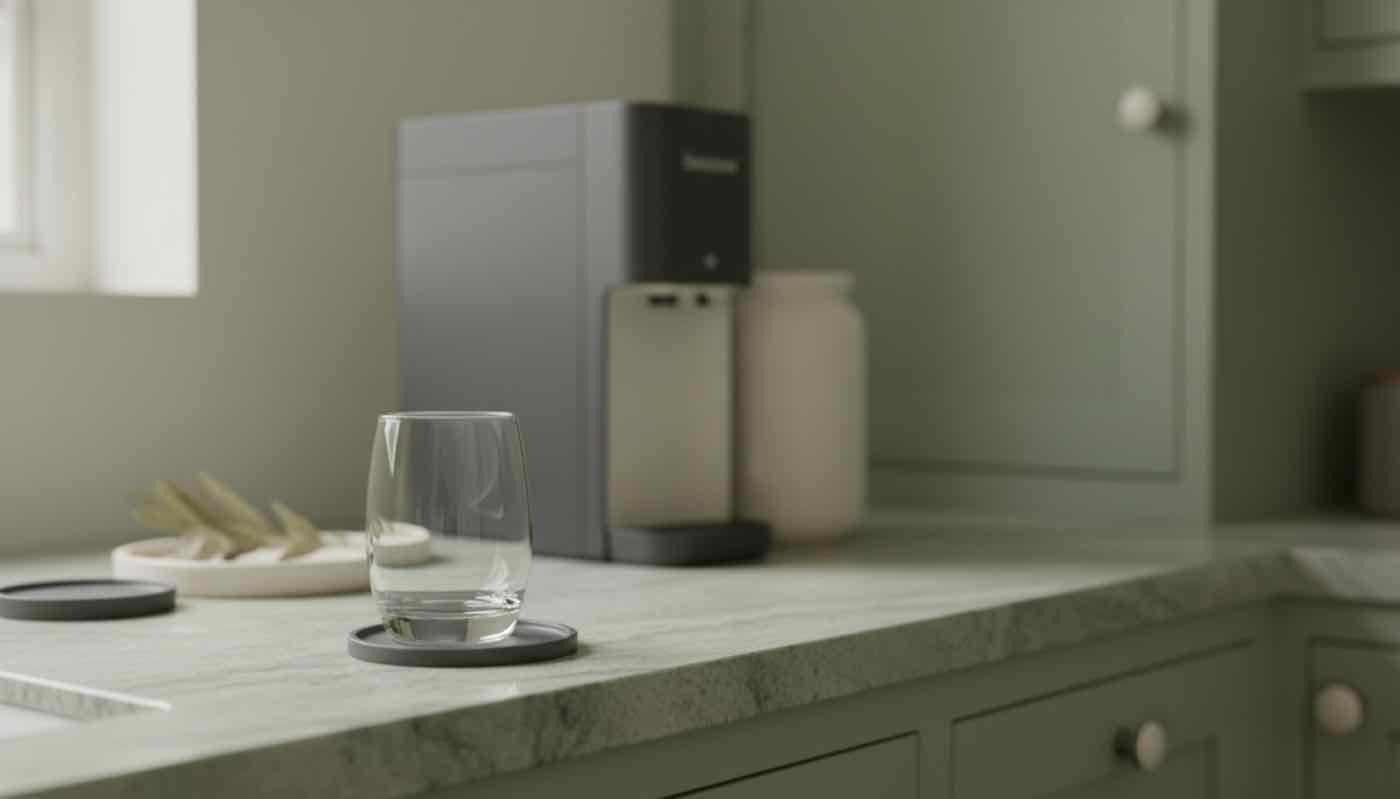
Best under-sink water filter: reverse osmosis and carbon, compared
Under-sink filters deliver filtered water on demand from a dedicated tap. We ranked reverse-osmosis and carbon systems on certified removal, install, and running cost.
By The PlasticFreeLab TeamUpdated June 28, 202613 min read
Disclosure·PlasticFreeLab tests and recommends independently. We sometimes earn a commission when you buy through our links. It never affects our rankings.
How the 91/100 was earned.
AquaTru Under Sink Reverse Osmosis
The under-sink AquaTru is tankless reverse osmosis with NSF certifications across Standards 42, 53, 58, and 401, the full set covering aesthetic contaminants, lead and VOCs, RO performance, and emerging compounds like PFAS and pharmaceutical residues. It delivers the broadest certified removal of any format on demand from a dedicated faucet, with a smaller footprint than a tanked system. For an owned home where you want maximum removal at the tap, this is the pick.
Everything we'd buy, in order.
- 01Best overall92
AquaTru Under Sink RO
Tankless under-sink reverse osmosis, NSF certified across 42, 53, 58, and 401: the complete set covering PFAS, lead, fluoride, chromium-6, and emerging compounds. Tankless means filtered water on demand without a storage tank sitting under the sink, and a smaller footprint. Filters out the broadest contaminant range of any household format. The tradeoffs are a dedicated faucet hole, some wastewater, and a higher cartridge cost than carbon-only systems.
SponsoredCheck Amazon - 02Best value88
APEC ROES-50 Under-Sink RO
A classic five-stage tanked reverse-osmosis system at roughly half the installed cost of most competitors. NSF-certified components, a well-documented install, and replacement filters you can source anywhere. The tradeoff versus tankless is a storage tank that takes up under-sink space and a slower recovery rate. If you own your home and want plumbed-in RO at the lowest sensible cost, this is the default. The most repairable system in the category.
 SponsoredCheck Amazon
 - 03Best premium tankless85
Waterdrop G3 Tankless RO
Tankless RO with NSF 58 and 372 certification and a TDS display on the faucet. The premium over APEC buys a smaller footprint, a faster flow rate, and the on-tap readout. It is noisier than a tanked system while filtering, and the proprietary cartridges cost more. Worth it if under-sink space is tight or you want the convenience features; APEC is the more boring, more repairable choice for the same core job.
SponsoredCheck Amazon - 04Best no-wastewater carbon84
Clearly Filtered Under-Sink (carbon)
A direct-connect carbon system with published third-party data showing reduction of PFAS, lead, and 200+ contaminants, with no wastewater and no storage tank. It installs inline without a separate faucet, so it is the simplest under-sink option, and it does not strip minerals the way RO does. It does not remove fluoride or dissolved solids as thoroughly as reverse osmosis. The pick for renters or anyone who wants strong carbon filtration without RO's wastewater and plumbing.
SponsoredCheck Amazon
Named, not hinted at.
Generic inline carbon cartridge
Skip for most62The cheap single-stage inline cartridges sold for refrigerator and under-sink use are usually certified only to NSF 42 for taste and chlorine. They will not reliably remove lead, PFAS, or fluoride. Fine if your only goal is taste and your water is already low-contaminant, but do not mistake them for a health filter. Step up to a certified carbon block or a reverse-osmosis system if removal matters.
How this comparison was made
- What we picked for
- Disclosed materials, third-party certification, durability in real cooking, independent contamination testing where available.
- How we evaluated
- Manufacturer disclosures, regulatory filings, peer-reviewed papers, and hands-on wear-testing. We read the labels and the filings, not the press releases.
- Who disagrees with us
- We steel-man the opposing view in every comparison, and name the brand we almost picked and the reason we didn't.
- What would change our mind
- New independent lab testing, reformulation by a ranked brand, or a peer-reviewed finding that contradicts our current reasoning.
What people ask us most.
- Reverse osmosis or carbon for an under-sink filter?
- Reverse osmosis removes the broadest range, including fluoride, dissolved solids, and the widest set of PFAS, but it installs with a tank or as tankless, costs more, and produces some wastewater. A certified carbon under-sink system removes chlorine, lead, VOCs, and (if certified for it) PFAS, with no wastewater and no mineral stripping, but it does not remove fluoride or dissolved solids. Choose RO if you want maximum removal and fluoride reduction; choose carbon if you want simplicity, no wastewater, and keep your concern to chlorine, lead, and PFAS.
- Do I need a plumber to install an under-sink filter?
- Not always. A direct-connect carbon system that runs inline on your existing cold line is within reach of most homeowners with basic tools. A reverse-osmosis system with a dedicated faucet requires drilling a hole in the sink or countertop for the faucet and tapping the cold supply and drain, which is more involved; many people do it themselves following the manual, but budget for a plumber if you are not comfortable. Renters usually cannot drill a faucet hole and should choose an inline carbon system or a countertop unit.
- Does reverse osmosis waste a lot of water?
- Older systems wasted several gallons per gallon produced; modern ones are far better. Traditional tanked RO systems historically rejected around 3 to 4 gallons to drain per gallon of filtered water. Newer tankless systems like the AquaTru and Waterdrop G3 have improved that ratio substantially, often to around 1:1 or better. The reject water is not contaminated waste in the toxic sense; it is concentrate that goes to your drain. If wastewater concerns you, a certified carbon system produces none.
- Does RO strip out healthy minerals, and does that matter?
- Reverse osmosis does remove most dissolved minerals along with contaminants, which is real, but the health significance is small for most people. The minerals in drinking water are a minor contributor to overall intake compared with food. The WHO has discussed remineralization mainly for taste and for plumbing reasons, not because demineralized water is harmful in normal amounts. If you prefer the taste of mineralized water, many RO systems offer a remineralization cartridge, or a pinch of mineral salt in a jug solves it.
- How does an under-sink filter compare to a whole-house system?
- They solve different problems and are often used together. An under-sink filter treats only the water at that one tap, but it can deliver the broadest removal, including RO-level reduction of fluoride and PFAS for drinking and cooking. A whole-house system treats every tap, including shower and laundry, but only for what high-flow carbon can address, so no fluoride and limited PFAS. The common setup is a whole-house carbon system for site-wide chlorine reduction plus an under-sink RO unit at the kitchen tap. We compare all four formats in our how-to-choose-a-water-filter guide.
New independent lab testing that contradicts our current ranking. A reformulation by a top pick that quietly drops a disclosed certification. A peer-reviewed paper that changes the safety picture on one of the materials above. We'll update this page within a week and mark what changed.
Sources we cited on this page.
- 01NSF International, Drinking Water Treatment Unit standards (42, 53, 58, 401)
- 02US EPA, Final PFAS National Primary Drinking Water Regulation (2024)
- 03WHO 2017, Guidelines for Drinking-water Quality, 4th edition (remineralization and RO water)
- 04EWG Tap Water Database
- 05AquaTru, NSF certification documentation
The PlasticFreeLab Team
A small group of researchers and writers cutting through the noise around non-toxic living. We read the studies, read the labels, test the products. We update our recommendations as the science evolves. We do not accept payment for product placement, we disclose every affiliate relationship, and we name the brands we reject.
Related in this hub.
- The Guide16 min
How to Choose a Water Filter: The Complete Buyer's Guide
Kitchen · Test your water, match the format to the contaminant, and read the NSF label. The complete guide to choosing a water filter without the marketing noise.
- The Comparison14 min
Best Water Filters for the Home: Countertop to Whole-House
Kitchen · We compared countertop, under-sink, and whole-house water filters on contaminant removal, flow rate, and cost per gallon. Here's our ranked pick.
- The Comparison14 min
Best Whole-House Water Filters, Tested and Ranked
Kitchen · Whole-house filters treat every tap, including shower and laundry. We ranked the systems on certified removal, flow rate, and cost per gallon, with the honest limits.
- The Explainer10 min
PFAS in Drinking Water: What It Is and How to Filter It
Kitchen · PFAS forever chemicals are turning up in tap water worldwide. Here is what the EPA and peer-reviewed studies show, and which filters actually remove them.
Get the Kitchen Swap Audit.
A printable checklist of 50+ kitchen items, each ranked swap now / swap eventually / don't bother. Free. Delivered instantly.
By subscribing, you agree to our Privacy Policy. One calm email a week. Unsubscribe anytime.
50+ items