
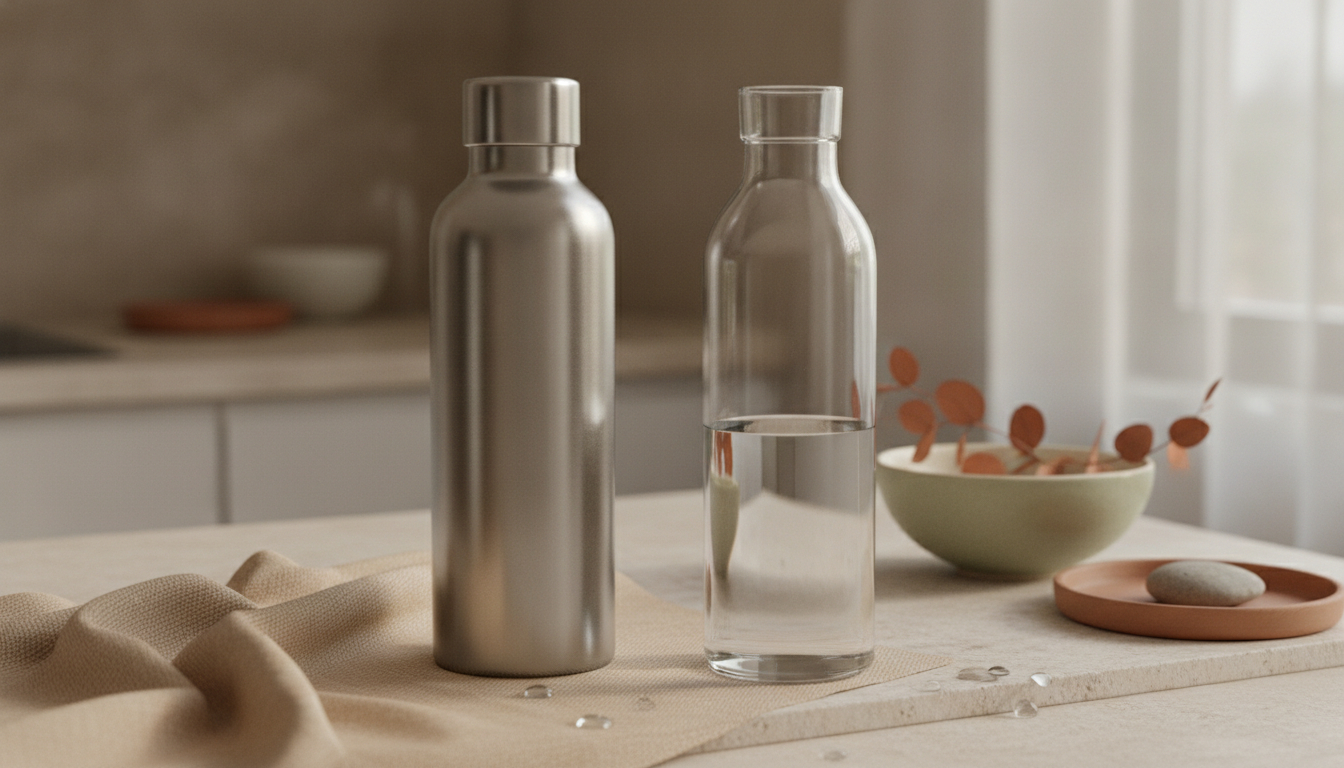
Best non-toxic water bottles
We tested stainless steel and glass water bottles for leaching, taste, and durability. Here's the editor's pick, the best glass option, and the one we'd skip.
Di La redazione di PlasticFreeLabAggiornato il June 16, 202614 min di lettura
Avviso·PlasticFreeLab prova e raccomanda in modo indipendente. Riceviamo talvolta una commissione quando acquistate tramite i nostri link — non incide mai sulle nostre classifiche.
Come è stato ottenuto il 91/100.
Klean Kanteen Classic (18/8 stainless)
The Classic is single-wall 18/8 food-grade stainless with no interior coating, which is exactly what we want from a non-toxic bottle: an inert surface and nothing to chip or wear through. Klean Kanteen has published its material specs for years, the lifetime warranty is real, and the bottle takes a beating without complaint. It's the one we'd hand a friend who asked.
Tutto ciò che compreremmo, in ordine.
- 01Best overall91
Klean Kanteen Classic (18/8 stainless)
Single-wall 18/8 (304) stainless with an uncoated interior, which is the honest non-toxic baseline: a food-grade metal surface and no liner that can degrade. Klean Kanteen lists the steel grade openly and backs the bottle with a lifetime warranty. Single-wall means it isn't insulated and it will sweat with ice water, so it's a daily-carry bottle rather than an all-day cold one. After months of drops it dents but never failed, and the metal taste people worry about never showed up in our use.
PubblicitàCheck Amazon - 02Best glass89
Lifefactory Glass Bottle (silicone sleeve)
Borosilicate-style glass is the most genuinely inert material you can drink from: nothing leaches, and you can taste the difference in plain water. The silicone sleeve gives you grip and survives most counter-height drops, though a hard tile fall can still end it. The plastic cap is the one compromise, so let hot or just-boiled water cool before capping. For anyone who can taste metal in steel, or who simply wants zero coatings of any kind, this is our first recommendation.
PubblicitàCheck Amazon - 03Best insulated88
Hydro Flask Wide Mouth (insulated stainless)
Double-wall vacuum 18/8 stainless that keeps cold water cold through a full work day and doesn't sweat. The interior is uncoated steel; the colored exterior powder coat never touches your water, which is the spec that matters. Heavier and pricier than a single-wall bottle, and the powder coat does chip cosmetically over time. If you actually need all-day insulation rather than just owning an insulated bottle, this is the sensible pick.
PubblicitàCheck Amazon - 04Best everyday carry86
Owala FreeSip Stainless
Insulated 18/8 stainless with a clever lid that lets you sip through a straw or swig from the spout. The steel body is the safe part; the lid and straw are plastic, which is true of nearly every insulated bottle and is fine for cold water. We like that the spout closes and locks, so it doesn't leak in a bag. The lid has a few small parts to clean by hand, but the bottle itself is straightforward and well made.
PubblicitàCheck Amazon - 05Best durability87
Yeti Rambler Bottle
Overbuilt 18/8 stainless that shrugs off the kind of fall that dents lesser bottles. Uncoated steel interior, vacuum insulation, and a thickness you can feel in the hand. That heft is the trade-off: it's the heaviest bottle here by a clear margin. The Chug cap is leak-resistant and easy to drink from one-handed. If you're hard on gear or live out of a truck, the Rambler is the one that outlasts you.
PubblicitàCheck Amazon - 06Best value glass84
Purifyou Premium Glass
Thick borosilicate glass with a protective silicone sleeve at a noticeably lower price than the boutique glass brands. You get the same inert-glass benefit (no leaching, clean taste) without the premium markup. The cap is plastic and the wide neck makes it easy to clean and add ice. It's heavier than steel and still breakable on hard floors, so it earns its place as a home-and-desk bottle more than a backpack one.
PubblicitàCheck Amazon - 07Best design85
MiiR Wide Mouth (insulated stainless)
Insulated 18/8 stainless with an uncoated interior and a clean, understated build that holds up. MiiR publishes a give-back tracker for each product, which is a transparency habit we wish more brands shared. Performance lands a half-step behind Hydro Flask on long cold retention, and the cap is plastic like its peers. A solid, quietly well-made bottle if the look matters to you as much as the spec.
PubblicitàCheck Amazon
Nominati, non lasciati intendere.
Generic unlined aluminum sports bottle
We'd skip48Aluminum bottles almost always have an interior liner, because bare aluminum is reactive with water and acidic drinks. The problem is the liner: cheap unbranded aluminum bottles rarely tell you what it's made of, and historically some bottle liners contained BPA-based epoxy. If a seller can't name the interior coating, treat that as your answer. Lightweight is the only real selling point here, and stainless or glass gets you safety you can actually verify. We'd skip it.
Come è nato questo confronto
- Criteri di selezione
- Materiali dichiarati, certificazioni indipendenti, durata in cucina reale, test indipendenti sui contaminanti quando disponibili.
- Come abbiamo valutato
- Dichiarazioni dei produttori, atti regolamentari, articoli peer-reviewed e prove d'usura sul campo. Leggiamo le etichette e i documenti, non i comunicati stampa.
- Chi ci contraddice
- In ogni confronto formuliamo nel modo più solido la posizione opposta e nominiamo il marchio che abbiamo quasi scelto, dicendo perché non l'abbiamo selezionato.
- Cosa ci farebbe cambiare idea
- Nuovi test indipendenti, una riformulazione di un marchio classificato o un risultato peer-reviewed che contraddica il nostro ragionamento attuale.
Le domande che ci arrivano più spesso.
- What is the safest material for a water bottle?
- Uncoated 18/8 (304) food-grade stainless steel and glass are the two materials with the cleanest safety record. Both are essentially inert: there's no coating to chip and no plastic to shed into your water. Glass leaches nothing at all, which is why it tastes most neutral. Stainless adds durability and, in vacuum-insulated form, temperature control. The thing to confirm on any steel bottle is that the interior is bare steel, not a colored liner.
- Are plastic water bottles actually unsafe?
- The concern is twofold. Many older or cheaper plastics can leach bisphenols like BPA or its substitute BPS, which research from NIEHS and others links to endocrine disruption, and the leaching increases with heat, sunlight, and physical wear. Separately, a 2024 study using a new imaging method found that bottled water contained far more plastic particles than previously measured, much of it nanoplastic. None of this means a plastic bottle is dangerous to touch, but for a bottle you refill and reuse daily, inert steel or glass removes the question entirely.
- Stainless steel or glass: which should I choose?
- Choose stainless if you want a bottle that survives drops, travels in a backpack, and keeps drinks cold or hot when insulated; the trade-offs are weight and a faint metallic note that a few people notice. Choose glass if taste purity matters most to you and you want a material that leaches nothing; the trade-offs are weight and the real risk of breakage. There's no wrong answer here. Both are genuinely non-toxic, so the decision is about your day, not your health.
- Is the colored coating on the outside of a steel bottle safe?
- The powder-coat or paint on the outside of an insulated bottle never contacts your water, so it isn't a leaching concern for drinking. It is purely cosmetic and tends to chip over time. The coating that would matter is an interior liner, and the safest steel bottles don't have one: the inside is simply bare 18/8 stainless. If a bottle has a coated or colored interior, ask the brand what it is before buying.
- What about aluminum water bottles?
- Aluminum is reactive with water, so aluminum bottles are almost always lined on the inside. That liner is the whole story. Reputable brands disclose a BPA-free liner and its material; cheap unbranded bottles often don't, and some older liners used BPA-based epoxy resins. If you already own an aluminum bottle you like, contact the manufacturer and ask exactly what the interior coating is. If you can't get a straight answer, we'd move to uncoated stainless or glass.
Nuovi test indipendenti che contraddicano la nostra classifica. La riformulazione silenziosa di una scelta in alto in classifica che perda una certificazione dichiarata. Uno studio peer-reviewed che cambi il quadro di sicurezza per uno dei materiali sopra. Aggiorneremo questa pagina entro una settimana e segnaleremo cosa è cambiato.
Fonti citate in questa pagina.
- 01NIEHS — Bisphenol A (BPA) overview and health research
- 02FDA — Bisphenol A (BPA): Use in Food Contact Application
- 03Qian et al. 2024 — Rapid single-particle imaging of nano- and microplastics in bottled water, PNAS
- 04Kamerud et al. 2013 — Stainless steel leaching of nickel and chromium, J. Agric. Food Chem.
- 05NSF — Drinking water and food equipment material certification (NSF/ANSI 51)
La redazione di PlasticFreeLab
Un piccolo gruppo di ricercatrici e redattori che taglia il rumore intorno alla vita non tossica. Leggiamo gli studi, leggiamo le etichette, proviamo i prodotti — e aggiorniamo le nostre raccomandazioni man mano che la scienza avanza. Non accettiamo pagamenti per il product placement, dichiariamo ogni rapporto di affiliazione e nominiamo i marchi che scartiamo.
Da leggere in questa rubrica.
- La voce8 min
Che cosa sono i microplastici? Una spiegazione semplice
Microplastici · I microplastici sono frammenti di plastica inferiori ai 5 mm. Ecco di cosa sono fatti, da dove provengono e cosa dicono con calma i dati sulla salute umana.
- La voce9 min
What Is BPA? And Is 'BPA-Free' Actually Safer?
Microplastici · What BPA is, where it hides, how the FDA and EFSA disagree, and why 'BPA-free' often just means a substitute that may be no safer.
- Il confronto14 min
Best Glass Food Storage Containers of 2026, Tested and Ranked
Cucina · We ranked 8 glass food storage sets on glass type, lid safety, and seal quality, with FDA and NIH sources and one we'd skip.
- Il confronto14 min
Migliori filtri per l'acqua: da banco, sottolavello o centralizzati
Cucina · Abbiamo confrontato filtri da banco, sottolavello e centralizzati per riduzione dei contaminanti, portata e costo al litro. Ecco la nostra raccomandazione classificata.
Ricevete l'audit della cucina.
Una lista stampabile di oltre cinquanta articoli da cucina, ciascuno classificato come sostituire ora / sostituire più avanti / nessun problema. Gratuito. Consegnato subito.
Iscrivendovi accettate la nostra Informativa sulla privacy. Una mail sobria a settimana. Disiscrizione in qualsiasi momento.
50+ articoli