
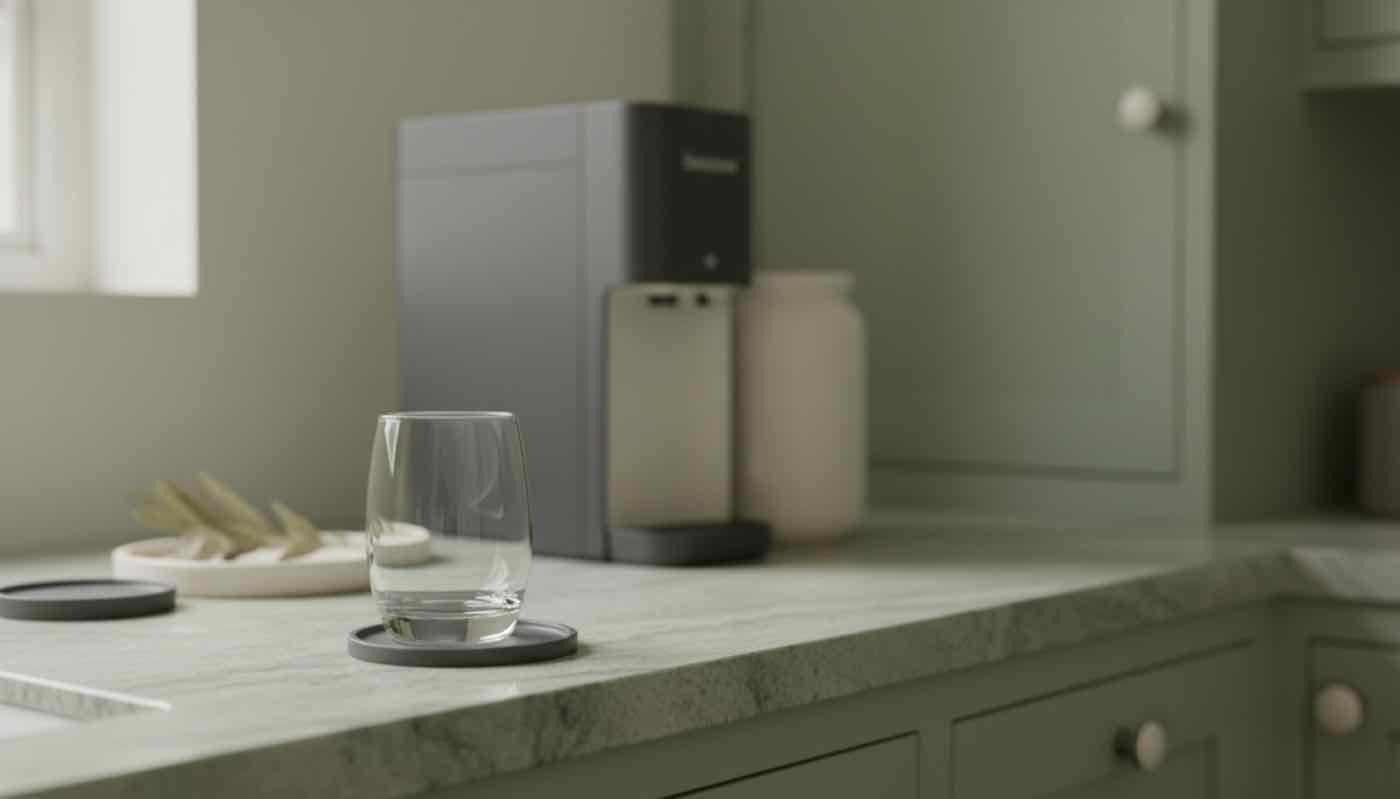
Migliori filtri per l'acqua di casa: da banco, sottolavello o centralizzati
Abbiamo confrontato filtri da banco, sottolavello e centralizzati per riduzione dei contaminanti, portata e costo al litro. Ecco la nostra raccomandazione classificata.
Di La redazione di PlasticFreeLabAggiornato il April 20, 202614 min di lettura
Avviso·PlasticFreeLab prova e raccomanda in modo indipendente. Riceviamo talvolta una commissione quando acquistate tramite i nostri link — non incide mai sulle nostre classifiche.
Come è stato ottenuto il 93/100.
AquaTru Countertop Reverse Osmosis
AquaTru is the only countertop filter we found with NSF certifications across the four standards that matter (42, 53, 58, and 401), meaning independent labs have verified removal of PFAS, lead, fluoride, and pharmaceutical residues. No plumbing required, no under-sink install, and filter replacement is tool-free.
Tutto ciò che compreremmo, in ordine.
- 01Best overall93
AquaTru Countertop RO
Four-stage reverse osmosis in a countertop unit that plugs into a standard outlet. NSF certified to Standards 42, 53, 58, and 401: the full set that covers aesthetic contaminants, health-related contaminants, RO performance, and emerging compounds like PFOA, PFOS, and BPA. No plumber needed. Filters last six months to two years depending on stage. The tradeoff: you refill a tank, you wait, and it produces wastewater.
PubblicitàCheck AquaTru - 02Best gravity filter82
Big Berkey Gravity Filter
A steel canister with ceramic-composite Black Berkey elements that uses gravity. No electricity, no plumbing. Independent lab reports show strong reduction of lead, chlorine, pathogens, and many VOCs. NSF certification is the weak point: Berkey does not hold NSF 53 on PFAS, and they've had regulatory disputes in California and Iowa. Excellent for off-grid, camping, and power outages. For daily home use with a grid connection, AquaTru's certification story is cleaner.
PubblicitàCheck Berkey - 03Best budget84
Epic Pure Pitcher
A pitcher-format filter with published third-party testing against 200+ contaminants including PFAS, lead, chromium-6, and pharmaceuticals. Made in the US, replaceable cartridges, nothing to install. Slower flow than a Brita and pricier per cartridge, but the contaminant removal is a full tier above any mass-market pitcher. The sensible starting point if $400 for AquaTru isn't in budget this month.
PubblicitàCheck Amazon - 04Best budget alternative80
Clearly Filtered Pitcher
Similar positioning to Epic Pure: published test data, strong PFAS and fluoride reduction, US-made. Cartridges last roughly 100 gallons. We'd flip a coin between Clearly Filtered and Epic Pure; both are honest products with transparent testing. Clearly Filtered's under-sink line is also worth considering if you want pitcher-grade filtration at the tap.
PubblicitàCheck Amazon - 05Best under-sink RO86
APEC ROES-50 Under-Sink RO
A traditional five-stage under-sink reverse osmosis system at roughly half the installed cost of most competitors. NSF-certified components, well-documented install, and filters that are easy to source anywhere. Requires a dedicated faucet hole and storage tank under the sink. If you own your home and want plumbed-in RO, this is the default pick. Renters should stick to countertop.
PubblicitàCheck Amazon - 06Best premium under-sink83
Waterdrop G3 Tankless RO
Tankless RO. Water is filtered on demand instead of sitting in a storage tank. NSF 58 and 372 certified. The premium over APEC buys you a smaller footprint and a TDS display on the faucet. Noisier than a tanked system when filtering. Worth it if your under-sink space is tight; otherwise APEC is the more boring, more repairable choice.
PubblicitàCheck Amazon - 07Best whole-house78
Aquasana Rhino Whole-House
Whole-house carbon and KDF filtration, rated for roughly 1 million gallons (about 10 years for a family of four). Reduces chlorine, chloramines, lead, mercury, and VOCs site-wide, including shower and laundry water. NSF 42 certified. Does not remove fluoride or dissolved solids. For that you still want RO at the kitchen tap. Install requires a plumber and a shutoff.
PubblicitàCheck Amazon - 08Budget honorable mention70
Brita Elite Pitcher
Brita's upgraded cartridge (formerly LongLast) is NSF certified to Standards 42 and 53 for lead, chlorine, and a short list of other contaminants. It's a real filter, not a placebo. The ceiling is low: no PFAS removal, no fluoride removal, no pharmaceutical claims. Fine as a bridge for a few months. Not fine as your permanent solution if you live anywhere with known PFAS contamination.
 PubblicitàCheck Brita
Nominati, non lasciati intendere.
ZeroWater Pitcher
Skip for most62ZeroWater's ion-exchange resin does reduce total dissolved solids and lead effectively per NSF 53. The problem is taste: strong reduction of minerals leaves the water flat, and the cartridges develop a fishy smell as they exhaust. Cartridge lifespan in cities with hard water is short, and cost per gallon is high. The Epic Pure does a better job for similar money.
Refrigerator In-Door Filters (generic)
Skip56Most factory fridge filters are certified only to NSF 42 (chlorine, taste, odor). They do not reliably remove lead, PFAS, or pharmaceutical residues. If your water source is municipally treated and you only want better taste, they're fine. For anything beyond that, don't rely on them as your primary filter.
Come è nato questo confronto
- Criteri di selezione
- Materiali dichiarati, certificazioni indipendenti, durata in cucina reale, test indipendenti sui contaminanti quando disponibili.
- Come abbiamo valutato
- Dichiarazioni dei produttori, atti regolamentari, articoli peer-reviewed e prove d'usura sul campo. Leggiamo le etichette e i documenti, non i comunicati stampa.
- Chi ci contraddice
- In ogni confronto formuliamo nel modo più solido la posizione opposta e nominiamo il marchio che abbiamo quasi scelto, dicendo perché non l'abbiamo selezionato.
- Cosa ci farebbe cambiare idea
- Nuovi test indipendenti, una riformulazione di un marchio classificato o un risultato peer-reviewed che contraddica il nostro ragionamento attuale.
Le domande che ci arrivano più spesso.
- Do I actually need a water filter?
- Probably, depending on your zip code. The EPA's 2024 final PFAS rule set enforceable limits at 4 parts per trillion for PFOA and PFOS, and utilities have until 2029 to comply. Until then, EWG's Tap Water Database maps known contaminants in your local system. Look yours up before deciding. If your system shows elevated lead, chromium-6, trihalomethanes, or any PFAS, a filter is the fastest intervention.
- Is reverse osmosis worth it?
- For PFAS and fluoride specifically, yes. RO is the only consumer-grade technology that reliably removes both. Carbon filters don't touch fluoride and have mixed PFAS performance. RO does strip minerals along with contaminants, which is a real tradeoff, but the idea that demineralized water is harmful in meaningful amounts isn't supported by current evidence. If you want the minerals back, remineralization cartridges or a pinch of sea salt in a gallon jug solves it.
- What's the difference between NSF 42, 53, 58, and 401?
- NSF 42 covers aesthetic contaminants (chlorine, taste, odor). NSF 53 covers health-related contaminants (lead, cysts, VOCs, chromium-6). NSF 58 is specifically for reverse osmosis performance. NSF 401 covers emerging compounds (BPA, pharmaceutical residues, pesticides). A filter certified to only 42 is not a health filter. Look for 53 at minimum, ideally 53 and 401, and 58 if it's an RO system.
- Does Berkey really not have NSF certification?
- Correct. Berkey publishes independent lab test reports from labs like Envirotek and NSF-accredited labs, and the results are strong. But the company does not hold full NSF product certification the way AquaTru or APEC do. That's a defensible choice for a small company (NSF certification is expensive), but it's a real gap in the paper trail, and it's the reason Berkey has faced EPA questions in the past.
- Will a water filter remove microplastics?
- Reverse osmosis and properly-rated carbon block filters remove microplastics above 0.5 microns, per multiple 2020-2023 studies. Nanoplastics, below 100 nanometers, are harder. A 2024 paper in PNAS (Qian et al.) identified nanoplastics in bottled water at up to 240,000 particles per liter; filtered tap water is almost certainly a lower-particle exposure route than bottled.
- What about shower filters?
- Worth considering if your water is chlorinated or chloraminated. Chlorine and chloramines volatilize in hot water and are inhaled during showers. The exposure route is real, though the health significance is still debated. A simple KDF shower filter reduces the chlorine smell and reduces skin irritation for many people. We'd call it a tier-two upgrade, not a priority over your drinking water.
Nuovi test indipendenti che contraddicano la nostra classifica. La riformulazione silenziosa di una scelta in alto in classifica che perda una certificazione dichiarata. Uno studio peer-reviewed che cambi il quadro di sicurezza per uno dei materiali sopra. Aggiorneremo questa pagina entro una settimana e segnaleremo cosa è cambiato.
Fonti citate in questa pagina.
- 01EPA — PFAS National Primary Drinking Water Regulation (April 2024)
- 02EWG Tap Water Database
- 03NSF International — Drinking Water Treatment Unit standards
- 04Qian et al. 2024 — Rapid single-particle chemical imaging of nanoplastics in bottled water, PNAS
- 05AquaTru NSF certification documentation
- 06WHO 2022 — Dietary and inhalation exposure to nano- and microplastic particles and potential implications for human health
La redazione di PlasticFreeLab
Un piccolo gruppo di ricercatrici e redattori che taglia il rumore intorno alla vita non tossica. Leggiamo gli studi, leggiamo le etichette, proviamo i prodotti — e aggiorniamo le nostre raccomandazioni man mano che la scienza avanza. Non accettiamo pagamenti per il product placement, dichiariamo ogni rapporto di affiliazione e nominiamo i marchi che scartiamo.
Da leggere in questa rubrica.
- L'inchiesta di fondo11 min
PFAS 'Forever Chemicals': What They Are and Where They Hide
Microplastici · A calm, cited guide to what PFAS are, why they persist, where they hide in daily life, and practical ways to reduce your exposure.
- La voce8 min
Che cosa sono i microplastici? Una spiegazione semplice
Microplastici · I microplastici sono frammenti di plastica inferiori ai 5 mm. Ecco di cosa sono fatti, da dove provengono e cosa dicono con calma i dati sulla salute umana.
- Il confronto14 min
Best Non-Toxic Water Bottles of 2026, Tested and Ranked
Cucina · We tested stainless steel and glass water bottles for leaching, taste, and durability. Here's the editor's pick, the best glass option, and the one we'd skip.
- La voce11 min
Brita vs. Berkey vs. AquaTru: filtro a gravità contro filtro da banco
Cucina · Brita, Berkey, AquaTru: tre filtri, tre usi diversi. Il confronto onesto con i dati sui contaminanti.
Ricevete l'audit della cucina.
Una lista stampabile di oltre cinquanta articoli da cucina, ciascuno classificato come sostituire ora / sostituire più avanti / nessun problema. Gratuito. Consegnato subito.
Iscrivendovi accettate la nostra Informativa sulla privacy. Una mail sobria a settimana. Disiscrizione in qualsiasi momento.
50+ articoli